
Timshel is a Hebrew word that means “thou mayest.” It implies choice, uncertainty, and possibility, as opposed to “thou shalt” or “thou will” which are commands that imply inevitability. The concept of timshel is at the thematic heart of John Steinbeck’s East of Eden.
About a year ago I read Steinbeck’s stunning and devastating The Grapes of Wrath (review here). This year, it was East of Eden, Steinbeck’s 700-page epic set in California’s Salinas Valley during the late nineteenth and early twentieth centuries.
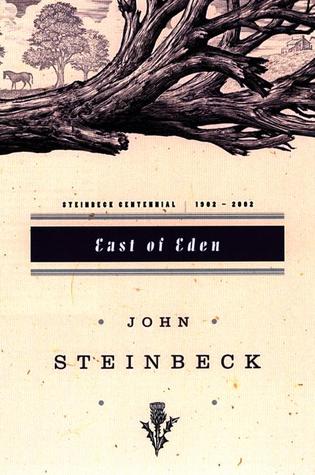
The story follows two generations of the Trask family, principally brothers Charles and Adam Trask and, later, Adam’s twin sons, Cal and Aron. The first letters of their names signal that their family history echoes the biblical story of Cain and Abel. The favored son and the outcast. The sibling rivalry and betrayal. The struggle between good and evil. Steinbeck never shied away from big themes.
Cal believes he inherited his mother Cathy’s seemingly infinite capacity for cruelty, while Aron is characterized as innocent and virtuous. The novel examines whether people are prisoners of their ancestry and circumstances or possess the freedom to choose their own paths. Perhaps a little of both, since rarely do complex questions have black-and-white answers.
Adding contrast to the Trask family is the Salinas Valley family of Samuel and Liza Hamilton and their children, a hardworking, imperfect, loving group of characters who own a ranch nearby to the Trasks.
The narrative goes back and forth among the characters, highlighting their decisions in the face of adversity, their struggles with morality and destiny. As Steinbeck writes, this is the central theme of all fiction:
“I believe that there is one story in the world, and only one. . . . Humans are caught—in their lives, in their thoughts, in their hungers and ambitions, in their avarice and cruelty, and in their kindness and generosity too—in a net of good and evil. . . . There is no other story.”
That claim may be open for discussion. When I was writing my first novel, Stash, I went to a workshop on how to write a pitch to attract a literary agent, and the workshop leader said that all stories boil down to: “Will Becky save the farm and live to tell about it.” I suppose Becky had to save the farm from some forces of evil, whether natural or manmade.
I digress.
If you want to read one of the titans of twentieth-century American literature, you can’t go wrong with Nobel Prize winner John Steinbeck. I slightly preferred the moral emergency of exploited and downtrodden migrants in The Grapes of Wrath, and East of Eden is equally worthy and powerful.
Now I get to watch the acclaimed East of Eden limited series Netflix produced this past year. I appreciate experiencing and comparing the same story in print followed by screen. It’s fascinating to me how writers and directors interpret written works of art for their own medium.

